
- Interviews
- Guide
Beyond the Gut Feeling: A Simple Guide to Better Interviews
Most interviews feel productive but leave you with little more than a gut feeling. Here's a simple way to run interviews that give you clear, fair signals about every candidate.
Think back to the last candidate you interviewed. Now try to explain, in two sentences, exactly why you said yes or no.
If the honest answer is something like "they just seemed like a good fit," you're in good company. Most interviews are friendly, well-meaning conversations that end with a feeling instead of a clear decision. That feeling is often right. But when it's wrong, it's expensive, and it's hard to work out what went wrong.
The good news is you don't need a complicated process to fix this. A few small habits make a big difference.
Start with what you need to learn
Before the interview, ask yourself one question: what do I need to find out about this person that the resume can't tell me?
Usually it's a short list. Can they solve the kind of problems this role faces every week? How do they work with other people? Do they take ownership when things go sideways? Pick three or four of these and build the interview around them. Anything else is a bonus.
When every interviewer knows what they're there to learn, you stop asking the same "tell me about yourself" question four times in one day.
Ask everyone the same core questions
This one feels a bit stiff at first, but it's the most useful change you can make. If every candidate answers the same main questions, you can actually compare their answers. If every interview goes in a different direction, you end up comparing personalities.
You can still follow up, dig deeper and have a real conversation. Just make sure the core questions stay the same from one candidate to the next.
Ask about things that really happened
"How would you handle a difficult stakeholder?" invites a textbook answer. "Tell me about a time a stakeholder pushed back on your work. What happened, and what did you do?" gets you a real story.
Real stories have details: names, numbers, mistakes, and what the person learned. Those details are where you find out what someone is actually like to work with.
Write things down straight away
Memory is generous to people who were charming and harsh on people who were nervous. Take a few minutes right after each interview to note what the candidate said and how they did against each of the things you set out to learn.
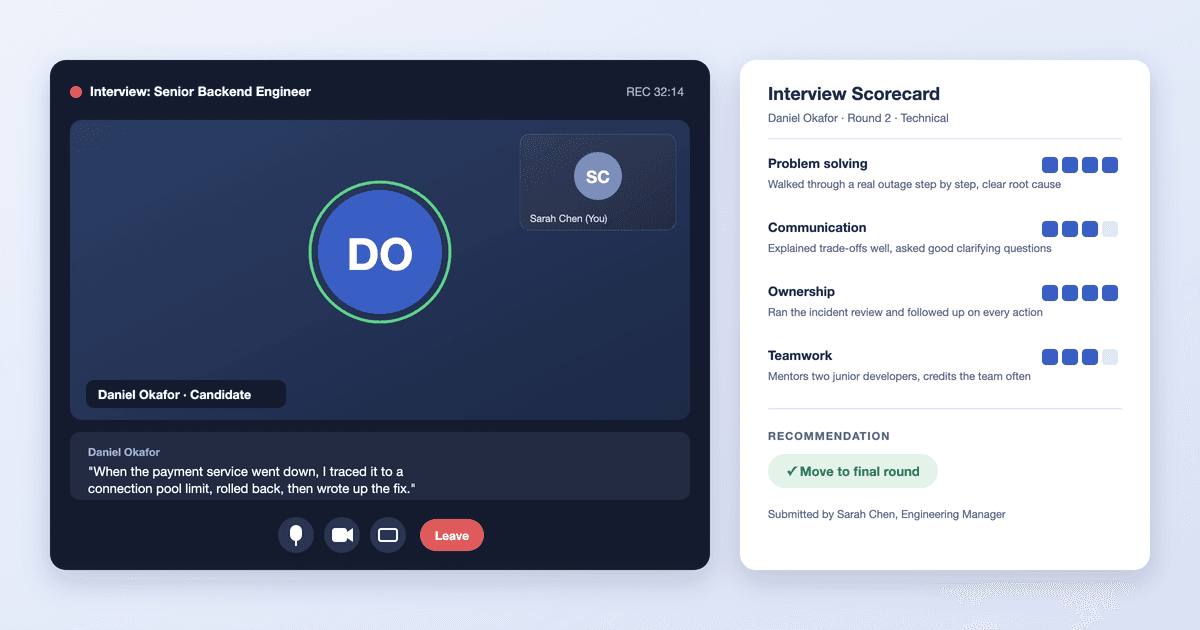
A simple scorecard works well. One line per skill, a rating from 1 to 4, and a sentence or two of evidence. Skip the middle option if you can. It forces you to make a call.
Decide separately, then compare
If the whole panel talks it over before anyone has written their own view, the loudest or most senior person tends to set the tone. Ask each interviewer to submit their feedback first, then get together to discuss.
You'll be surprised how often people picked up on different things, and how much better the final decision is because of it.
Be kind to the candidate
A structured interview doesn't have to feel like an exam. Tell candidates what to expect, leave time for their questions, and get back to them quickly whatever the outcome. People remember how they were treated in an interview long after they forget the questions.
Where SiftHire helps
SiftHire is built to take the busywork out of this. You can schedule interviews with the candidates you've shortlisted, run AI-assisted first-round interviews for high-volume roles, and collect structured feedback from every interviewer in one place. When it's time to decide, the whole panel's notes and ratings sit right next to the candidate's profile, so the conversation is about evidence rather than memory.
Your team still makes the call. It just has a lot more to go on.
A quick checklist before your next interview
- Pick three or four things you need to learn about the candidate
- Prepare the same core questions for everyone
- Ask about real past situations, not hypotheticals
- Fill in your scorecard within the hour
- Share your own feedback before the group discussion
- Let every candidate know what happens next
Good interviews aren't about being tough or clever. They're about being clear on what you're looking for and giving every candidate a fair chance to show it.
Bring your whole interview process into one place? Try SiftHire free at https://next.sifthire.com/