
- Resumes
- Article
The Resume Pile Problem: Why Good Candidates Slip Through and How to Catch Them
Most hiring teams don't miss great people because they're careless. They miss them because there are too many resumes and too little time. Here's how to fix that without cutting corners.
You post a job on Monday. By Wednesday you have a few hundred applications. By Friday you've read maybe forty of them properly, skimmed another sixty, and the rest are sitting in a folder you keep meaning to get back to.
If that sounds familiar, you're not doing anything wrong. That's just what hiring looks like now. Applying for a job takes a couple of clicks, so every opening gets a flood. The hard part has moved. It isn't finding candidates anymore. It's noticing the right ones before someone else hires them.
Where good candidates get lost
From talking to recruiters and hiring managers, the same few problems come up again and again.
1. Formatting beats substance.
A clean, well-designed resume gets read. A two-column PDF with odd fonts, or a plain Word document someone wrote in 2015 and kept updating, gets skimmed. Neither tells you much about how good the person actually is at the job.
2. Keyword matching is too literal.
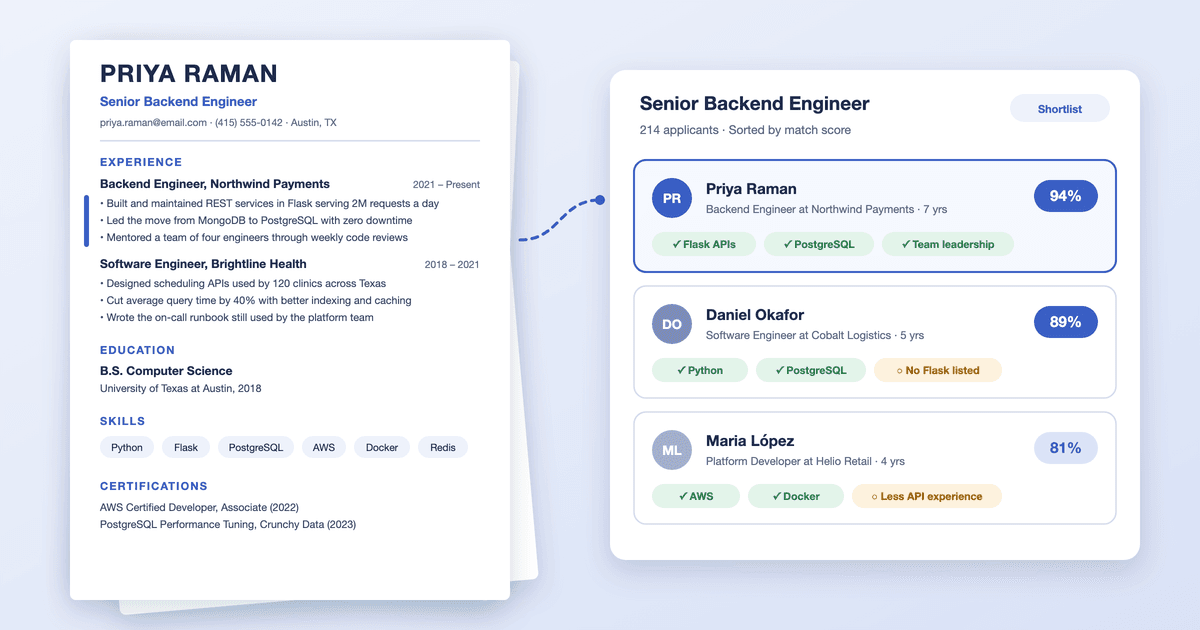
Someone who "built and maintained REST services in Flask" is a backend developer, even if the words "backend developer" never appear on the page. Simple keyword filters miss that kind of thing all the time.
3. Order matters more than it should.
Whoever applied first, or whoever happens to be at the top of the list, gets the most careful read. Application number 212 gets a tired glance at 6pm.
4. Everyone reads differently.
Two people on the same team can look at the same resume and come away with very different opinions. Without a shared picture of what "good" means for the role, screening ends up being about who did the reading.
What actually helps
You don't need to read faster. You need a better first pass so your attention goes where it matters.
Agree on what the role really needs
Before you open a single resume, write down three to five must-haves and a short list of nice-to-haves. Keep it specific. "Strong communication skills" isn't much use. "Has written technical docs or worked directly with clients" is.
This step costs you fifteen minutes, and it makes everything after it more consistent.
Turn every resume into the same shape
The biggest time sink in screening is hunting for information. Where did they work? For how long? What did they actually do there? When every resume is laid out differently, you rebuild the same picture from scratch each time.
Pulling resumes into a standard structure (contact details, experience, skills, education) lets you compare people side by side instead of decoding each document. This is the part where software genuinely earns its keep.
Match on meaning, not just words
Look for evidence of the skill, not just the label. A good screening process, whether done by a person or a tool, should understand that "led a team of four engineers" counts as leadership experience, and that "Postgres" and "PostgreSQL" mean the same thing.
Keep a human in the loop
Automation is great for sorting and summarising. It shouldn't be the one making the final call. Use it to bring the strongest matches to the top and flag the interesting outliers, then let a person decide who moves forward. That keeps your process fair and makes it easy to explain your decisions.
How SiftHire fits in
This is exactly the problem we built SiftHire to help with. When resumes come in, SiftHire parses them into a clean, consistent profile and scores each one against the requirements of the role. Your team sees a ranked shortlist with the reasons behind each match, so you can spend your time on conversations instead of copy-pasting details into a spreadsheet.
You still make the decisions. You just make them with the full picture in front of you, whether it's the first application or the three hundredth.
A quick checklist for your next opening
- Write down your must-haves and nice-to-haves before you start screening
- Get every resume into the same format so comparisons are fair
- Look for evidence of skills, not just matching job titles
- Give application #200 the same attention as application #2
- Let tools do the sorting, and let people do the deciding
Great candidates are almost always in the pile. The goal is simply to make sure you see them.
*Want to see how it works on your own open roles? [Try SiftHire free (opens in a new tab)]*